

 Agricultural Autonomy Institute joins Harper Adams University's 125th anniversary celebrations
A leading American expert in agricultural autonomy has paid tribute to Harper Adams University as it marks its 125th anniversary.Dr Alex Tho …
Posted 22 October
Each year, students from a wide range of Harper Adams University undergraduate courses spend 12 months working in industry on placement.
In this guest blog, third year BSc (Hons) Agriculture with Crop Management student Murray Gates reflects on his current role – working as an Assistant Field Research Scientist with advisory service ADAS.
After viewing other universities offering a similar agricultural course, coming to Harper Adams was an easy decision. The placement year offered the chance to gain experience in a completely new area of agriculture that I had very little experience in.
Coming from a potato and onion farm, I had developed a great interest in the arable and root vegetable side of agriculture, so I chose to do Agriculture with Crop Management. The crop growth and protection modules taught me invaluable knowledge and skills which I have been able to apply and expand on over placement.
The placement I chose to apply for was for an Assistant Field Research Scientist role with ADAS.
ADAS specialise in independent applied research for sustainable food production. Research is carried out on a wide range of plant species at ADAS, from wheat to potatoes to bedding plants to Christmas trees.
A lot of the research is carried out in fields, however just as much research is done in polytunnels and glasshouses. I have really enjoyed this part of placement as I had very little experience working in these environments. Furthermore, there is some lab-based pathology work over the winter which has also been extremely interesting.
I am now well into my placement and my role so far has been extremely diverse, helping members of the field team with their various projects. I have been given the time to learn and develop new skills which has furthered my understanding of plant biology.
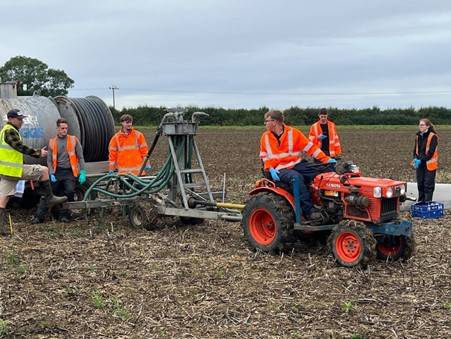
I was fortunate to be involved in a large-scale DEFRA funded slurry separation project. This saw us investigating the potential uses of having solid and liquid fractions of slurry so that they can be more accurately applied to fields depending on the field’s fertiliser requirements. Wind tunnels were also used in this project - which were placed over the plots and were able to monitor and calculate the gaseous emissions coming off the ground from different types of slurry spreading techniques and incorporation.
I was also involved in the bio-stimulant project which involved trialling different types of bio-stimulants on a range of crops such as raspberries and blueberries. This involved going to large scale raspberry and blueberry farms to apply the bio stimulants.Seeing the way these farms were run and talking to people that worked there was fascinating as it is a very different style of farming to the one I am used to.
Overall, I have thoroughly enjoyed placement so far and look forward to what the rest of the year has to offer.
Related Posts
Agricultural Autonomy Institute joins Harper Adams University's 125th anniversary celebrations
A leading American expert in agricultural autonomy has paid tribute to Harper Adams University as it marks its 125th anniversary.Dr Alex Tho …
Posted 22 October
 Sky's the limit: Helen joins MP's fundraising parachute jump
A charity skydive by a Harper Adams University Business Development Consultant has helped raise more than £16,000 for a new cancer cen …
Posted 21 October
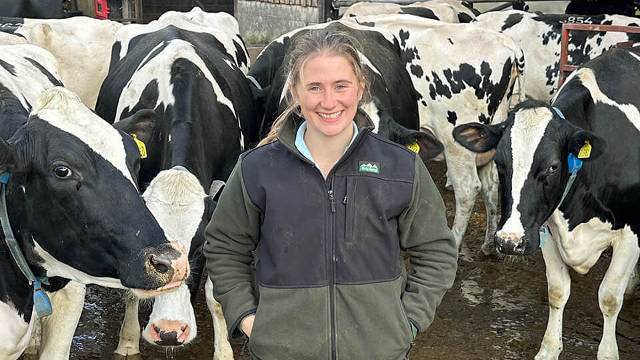 From dairy farm - to farm vet
Growing up on a dairy farm played a huge part in shaping Harriet Brimacombe’s ambition to become a vet. Now, as she prepares to …
Posted 20 October
 Listen: Archers anniversary marked with future of farming discussion on BBC radio
With BBC Radio Four marking the 75th anniversary of the Archers this year, Farming Today has taken the opportunity to look forwards this wee …
Posted 16 October